Essays & Poetry (mine or others) pertaining to historical and current events and burning social issues.

Friday, June 29, 2018

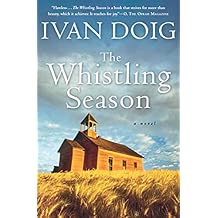
Review: The Whistling Season by Ivan Doig


The Whistling Season

Doig has such an irresistible way of drawing the reader in.
  In this novel, The Whistling Season he began with Paul Milliron,
a Montana state employee who’s assignment was to close
one room schools. His reflection goes back to the one room
school of his youth in Marias Coulee.
 The story is mostly told by Paul’s eleven year old self. Paul had
two brothers, Damon and Toby, the family baby and his
widowed father, Oliver.
By page two a newspaper advertisement was introduced
with the title: Can’t Cook But Doesn’t Bite.  Paul’s father
showed him the ad and there was some debate over not
whether to look into it, because the household had struggled
with four bachelors and disorder, but that Oliver also
needed someone to cook.
By the end of the first chapter, Paul was once again the
Montana state employee tasked with deciding the fate of
56 county rural schools aka one room school houses.

Chapter two plunges us into the saga of the Milliron family,
Friends and neighbors and their way of life. Doig seamlessly
time travels between the early 1900s and 1957, when his
character Paul is tasked with the duty of pushing progress
in Montana’s educational system.
In close to half a century, Paul Milliron witnessed monumental
change; He was philosophical about what was lost and what children
gained from a one room school education.

This story goes way beyond its own borders and could be a
metaphor for humanity’s wisdom when stupidity is usually,
initially an easier path.
As Doig added characters and complications and they affected
the Milliron family, we can see how they could just as well
be us.
Frankly, at the end, I was impressed with the choices of two young boys
and I believe you, the reader, will be, too! The ending underscores
the power of love and Doig gives us all hope!

I heartily recommend The Whistling Season.

Raintreepoet, reporting.

Wednesday, June 27, 2018

Review: LUST FOR LIFE


A novel of Vincent Van Gogh
By Irving Stone.
Illustrated with 150 reproductions of Vincent Van Gogh's
paintings, arranged by J.B. Newman.
Copyright 1934 by Irving Stone.
Copyright 1937 by The Heritage Club.
Printed in the United States of America.

To begin with the book is bound in a reproduction of a
Van Gogh painting that depicts a rich farmland--so very
Vincent.
Vincent Van Gogh led a hard working, driven life. He dirtied
his hands with miners and farmers and drew and painted them
as he self-educated himself in his art.
Vincent was supported by his younger brother, Theo who was
an art dealer and who believed fiercely in his brother Vincent.
Theo supported Vincent for several years so that Vincent could
concentrate solely on his art.
Vincent was a man of great conscience and felt guilty taking
money from Theo on a wish and a promise. Despite giving
Theo all his work to sell, Vincent never felt worthy.
As Irving depicted and history reflects, Vincent dressed like a
bum, was unkempt and had frequent bouts of starvation to the
point of fever and illness. Still he was so driven, he produced
a painting every day.
After Vincent failed to become a minister like his father, Theo
 talked him into moving to Paris to live with him. There Vincent
met Gauguin, Seurat, Cezanne, Lautrec and many other
 "Impressionist" artists.
With  a new artistic vision, Vincent moved to Arles where there was
so much sunshine, yellow entered his art. (Little did he know that
"Sunflowers" would one day sell for $88 million dollars at auction.)
Vincent's final destination was Auvers, where he welcomed Gauguin,
so they could paint together. Arguments ensued and Gauguin left.
Vincent, desconsolate eventually went mad. He died a prolonged death
from a self-inflicted gun shot wound. Theo held him in his arms and
promised to create a gallery of Vincent's art.
Unfortunately, Theo died six months after Vincent. Thanks to Theo's
widow, the brothers were buried side by side in Auvers.
 Sunflowers grace both graves.
This Irving Stone book was labeled a novel because Stone had to
fill in some blanks to make the story. However, his main source
was 700 letters that Vincent wrote to Theo during these crucial
years. It could have well been Vincent's memoir. Great read and
even greater illustrations.
I highly recommend it.

raintreepoet, reporting.

Thursday, May 24, 2018

Reflections on a Frayed Friendship

Image result for image of tug of war


Dear Beacon Rock Oracle,

A friend began sending heated political emails to me a
few weeks ago. She's retired and I am still working.
I do not have time to keep up with all the news and it is
my instinct, when I lack the full facts to reserve judgment.

However, I do have opinions, which I shared, much to
my own dismay because within three or four emails ex-
changed, she burned down a treasured friendship that
began in the 80s. We are now in our 60s.

I am now thinking that I need  to disconnect from any
"friends" who connect with me rarely in person, but
act like we are best buds online. I have come to the
conclusion that we have grown in other directions and
 these communications are the last vestiges of letting go.

In my opinionated opinion, a clean break is less
painful. Especially, when one is being accused and
indeed is innocent.

I did nothing to this woman, but be her friend.
Whatever she is going through personally, was
suddenly puked on me.

 The only thing I can think of is that she is a livid Trump- hater
 and seems tweaked that I don't join her. I refuse to give that
 reprobate my attention/power.

What more could I have done?

Wondering in Vancouver


Dear Wondering in Vancouver:

You could have done nothing more. You are right
on the money with "we have grown in other directions."
It sounds like your retired friend has time on her hands
and maybe didn't plan ahead about how to best enjoy
her retirement.

And I agree, cutting loose from FaceBook and email friendships may
 make you happier in the long run. The less investment,
 the cheaper the product, I always say.

With 7+ billion souls on the planet, I am sure you can find
many new, kinder friends.

Friday, April 20, 2018

Grant should not be taken for Granted


Grant By Ron Chernow (2017, Hardcover) Free Shipping

Ulysses S. Grant, Civil War General and
United States President
Born: April 27, 1822
Died: July 23, 1885

The last time I posted I was in the middle of
 reading GRANT by Ron Chernow.
I've been in reading mode the last few months
and have read several satisfying books, however,
Ron Chernow's tome still trumps everything I've
read in years.
At 1,104 pages, GRANT is the best historical
writing this history buff has ever read. Chernow's
biography of GRANT could best be described as
creative non-fiction. It reads like a very good novel
and was a page turner to the end.

Grant was personally slandered and libeled and actually
dismissed as a "drunk" while winning wars and running
the United States as our 18th president, serving two
terms shortly after turning the tide of the Civil War,
being the only general Abraham Lincoln said would
fight. As a result Grant brought the south to its knees
and yet was a total gentleman when he tendered Lee's
surrender. Now that's a class act!

Jealous, lesser men could not accept nor understand
Grant's integrity and unwillingness to succumb to
ordinary ego. Grant was humble to a fault.His presidency
was rumored to be corrupt, when in fact, U.S. Grant
was simply surrounded by corrupt men. He did not
recognize the dark side of others because he himself
was honest and trustworthy. Grant saw the best in
 other human beings. That was his fatal flaw.

A 20 cigar per day habit finally ended Grant's life,
but not before he spent an entire year penning his
memoirs to have a nest egg for his family.
His friend, Mark Twain sold 300,000 subscriptions
and encouraged Grant in his final days. The memoirs
garnered what in today's money would be roughly
8 million dollars--a best seller in any era.

I highly recommend GRANT by Ron Chernow. I am
still reading Ulysses S. Grant's memoir, which is also
a tome.

raintreepoet, reporting.

Monday, January 15, 2018

How about Martin Luther King and Ulysses S. Grant Day, eh?

Image result for free images of MLKImage result for free images of General Ulysses S. Grant

Today is Martin Luther King Day. We have time off (teachers as well
as others in government positions) to pay homage to Martin Luther King. 
I am white, non-prejudiced, and have carried some shame for what my 
race has perpetuated onto the black race. 
Needless to say, I am an admirer of MLK's leadership and sacrifice to
help his people. In other words, I get why this recognition of MLK is 
important. 

However, as a history buff, I hate when other important figures, in a cause, 
are overlooked. The person I refer to is Ulysses S. Grant- the guy who led 
the northern armies to win the Civil War and free the slaves.
 ( He also served two terms as a U. S. president.) More than that
Ulysses S. Grant gave refuge to thousands of runaway slaves; clothed them,
fed them, protected them and also drafted thousands of them to fight the 
Confederacy, their former masters and subjugators.

As I read GRANT by Ron Chernow, I wonder, "Do black citizens of this
country know what Grant did for them?" 
There is no Ulysses S. Grant Day. He is not included in the celebration of
important presidents. Grant is not one of the faces on Mt. Rushmore. 
Excuse me! Who accomplished more to save our union than Ulysses S Grant?
Who fought harder to free the slaves?
I do wonder if Martin Luther King was aware of who Ulysses S. Grant was
and what he did for the black race. 
Keep reading, folks. GRANT by Ron Chernow would be a good start. 
I honor both MLK and U. S. Grant as the two men most prominent in 
fighting for equality in the United States of America.! 


raintreepoet, ruminating.

Sunday, December 24, 2017

Best Fruitcake, according to Ralph


Image result for images of fruitcakes

In a chat with red-haired Ralph at Opryland Theme Park ticket booth,
where we were working in December 1995, I shared with him that I
hated fruitcake. Ralph told me that he had a recipe that he was sure
I'd love. I didn't try it until many years later, and Ralph may be making
fruitcake in heaven by now, but he was one wise old Tennessee man.
Here's the recipe, with my healthy updates.

12 oz. light raisins (yellow)
12 oz, dried cherries or cherry cranberries
12 oz. dried apricots, chopped
1 cup semi-sweet chocolate chips (miniature)
1 pound pecans, chopped
1 pound almonds, chopped
2 cups shredded coconut
14.4 oz. chocolate or regular graham crumbs
2  regular sized sacks of marshmallows
1 cup apple or orange juice

In a very large pan, mix all ingredients except juice and marshmallows.
Over heat, melt marshmallows  in the juice and mix well.
Pour over the dry ingredients and mix well. Pack in 5 loaf pans.
(if foil, line with wax paper) or ten mini-pans. Cover with wax paper
lined tinfoil and refrigerate for about 14 days.

Wishing you a joyous holiday season,
Raintreepoet.

Tuesday, November 21, 2017

In these challenging times "The Little Red Hen" has a message for parents

This contributed by a friend:


The Little Red Hen: A Little Golden Book (50th Anniversary Editions) by Evelyn M. Begley - Used (Good) - 0307300978, WesternWhen I was a child, my mother taught me to read with the help of a book of fairy tales. We would sit together and work our way through the stories, sounding out the words, syllable by syllable. (This was in the era before pre-K programs, Sesame Street, and educational apps.) All that was required was a mother with time and a book from the library. By using this simple, time-tested method, both of my sisters and I were taught to read before we entered the first grade.

In addition to helping us to learn the English language, the stories often imparted a moral lesson. As we read the stories, we also discovered something about how society expected us to behave.

One of the most powerful moral lessons is found in the tale of The Little Red Hen. As young children like animals, this story is set in a barnyard, and the protagonist was a little red hen. One day the little red hen finds some wheat seeds. She explains to her three barnyard companions (a lazy dog, a sleepy cat, and a noisy yellow duck) that with the seeds, they can make bread. She then asks, "Who will help me plant the seeds?" They all reply, "Not I." She then proceeds to plant the seeds herself.

When the wheat is ready for harvesting, she again asks her friends, "Who will help me reap the wheat?" Once again, they all say, "Not I". At each step in the process (milling the wheat, making the dough, and baking the bread), she repeatedly asks if they would help, and they consistently refuse to offer any assistance.

Finally, the bread is baked, and the little red hen wearily turns to her friends and asks, "Who will help me eat the bread?", to which they all enthusiastically cry, "We will!"

When my mother and I first read the story together, she closed the book at this point and asked me what should happen next in the story.

"The little red hen should eat the bread herself."

"But what about her friends? They want some of the bread too."

"They didn't help her make it! They shouldn't get any of it!"

My response to the story was similar to that of most children and that of the little red hen, who responds rhetorically to her question, "I will!"

It is very interesting that, after twelve or more years of education, most people's response to the story's moral message becomes much more ambiguous. Their indigent, childhood declaration of "You don't work, you don't eat!" becomes "Well, there is enough bread for everyone ... right?"

What in their education has subverted their earlier moral sense?

The answer is simply that they have succumbed to an intellectual con game: their teachers, books, etc. have told them that the lazy dog, sleepy cat, and noisy yellow duck are merely victims of circumstances beyond their control; through no fault of their own, they cannot provide for themselves, and it is the moral obligation of the little red hens to feed them.

Some time after I learned to read and before it was time to teach my own children to read, such books of folk tales largely disappeared. They were replaced by Dr. Seuss, books of gibberish completely devoid of any moral content, or the Children's Television Workshop, which taught my kids to ask Santa for a Tickle Me Elmo.

Is it at all surprising that children today possess no moral compass? Most busy parents have largely delegated the teaching of morality to the schools, and the schools have either avoided the teaching of any moral message out of fear of offending someone or more often promulgated a philosophy of self-sacrifice.

In an adult barnyard story (George Orwell's Animal Farm), one of the first acts of the revolutionaries is to relieve the parents of the burden of their children's education. Later in the story the parents are horrified to discover what their children have become.

At a time of frenzied concern about the epidemic of school shootings, maybe it is time for parents to ask themselves, "Who will help educate my child?", they need to answer, "I will!

Grant Merrill
January 29, 2013

(696 word)