Essays & Poetry (mine or others) pertaining to historical and current events and burning social issues.

Thursday, September 1, 2016

Daddy Sold the Farm


Image result for free 1950s dairy farm images

I live in a condo village now. I feel encroached upon
and think constantly about the pastoral peace of my 
childhood. I was raised on a half section of bucolic
rolling hills surrounded by evergreen forest and a fruit
orchard behind the ranch house. In three years I will retire.
 You can bet your sweet buttermilk, I'll be looking for a 
way to get back to country living. 
I wrote this song when I was 19 and fresh off the farm.
I have adapted over the years, but the yearning has never
left me.

[G]Life ain’t been the same since [D] Daddy sold the[G] farm
He[C] sold a little piece of my[D] soul and broke my[G] heart
[D]Those people cut the farm[C] into a thousand[D] plots
With a[C] thousand tract [D]houses and an[C] apple tree
In every[D] yard
The[G] land will never[C] be the same
Since[D] Daddy sold the[G] farm

[D]The man who bought it, said it would always be the[G] same
[C] That he loved Daddy’s land,[D] too, but[G] could he change the[D] name
[G]Well, it’s now Pleasant Valley ([D]What a lovely[G] name)
But since Daddy let him[C] change the name
It’s [D]never been the[G] same

[D]Daddy’s doin’ fine now, a hundred thousand, after[G] taxes
[C]Except he’s now[D] into a higher income[G] bracket
The man who loved Daddy’s land, [D]must be smilin’
Without a [G]care
Cuz there ain’t too many[C] taxes that’ll[D] hurt
A multi-[G]millionaire

(Repeat chorus-first stanza)

[D]I’m the only one who ain’t smiling[G] now
[C]Since I have to live in[G] town
And [D]raise my kids on pavement
Instead of grassy[G] ground
And the[D] values that I learned
Won’t keep them from much[G] harm
Cuz we have to be city[C]-dwellers
Since[D] Daddy sold the [G]farm!


(Repeat chorus)

This will be in my "A Farmer's Daughter" chapbook.
raintreepoet, reporting.

Monday, August 22, 2016

Kayakcident


Image result for images of kayakers in rapids


Come boating with us,
 tomorrow, she implored
 I, by my nature, am not a water baby, but
 decide I need to stretch my spontaneity
 Ever cautious and wanting to sleep on it
   by morning I call to say: sounds like a grand idea!

 I am instructed to bring a swim suit,
  attire I have not worn in years
  Digging through a drawer, I find
 an old black bikini botto
 and supplement it with
a black, French-cut brassiere
 I’ve found that nobody’s the wiser,
  if you omit informing them.

 As I drive in I see that
 my friends Bob and Angie have\
a well-built vintage 19 foot wood boat,
  and Angie’s little 9 foot blue kayak
 attached tightly to the boat trailer
  Glorious hot day in the nineties
  Refreshing cool breeze on the Lewis River
  which is for the most part calm,
 smooth as an empty dinner platter
  except for the occasional level 1-2 rapids

 Angie paddles along, exploring the bank                       
 at her own pace, as Bob throws out a fish line
 and casually trolls for a bite Bob and I chat
 about politics and the economy
 We slide easily through a length of rapids
                        thinking nothing of it

  Then Angie offers me the kayak
and the adventuress in me burbles: Yes!
   I should interject here and now:
 First time in a kayak!
 The first rapids go by okay as I get
   my sea legs, by the second I am
   almost cocky

   It’s the third set, which increase to level 4
 that are hell-bent on humbling me and indeed they do!
  The consensus is that the wood boat
 will take the lead, as the water bucks high
 about the time they struggle with a whirlpool
    and holler: Back paddle!    which I was trying to do
 The kayak slams into the larger boat,
 pulled down in the swirling cool water
  my eyes open, it is crystalline and refreshing, 
holding my breath instinctively,
 there is no gasping or fear 
I simply propel myself up and
  grab a big root ball

 The kayak, wedged into the root ball
 is clearly stuck
 Angie yells at me to swim away
 or the whirlpool will pull me down
 The kayak paddle on one wrist
 big straw hat in other hand 
I   kick, mightily
as the current sweeps me like a buoyant
leaf, downstream

 Kicking for all I am worth
 I cover a football field’s length diagonally,
 before my feet find the rocky bottom
 So exhausted and grateful
 for the loaned life vest
 understanding in a heartbeat
how people’s lives are swallowed by rivers

   Wading back to the island
    I rejoin my friends 
who are ready to abandon their kayak
 saying: It is too dangerous
 to retrieve
 I hear myself say: We can at least try!
 We try lassoing it, to no avail
 Then a hero happens along
 and wrestles it off the root ball

 Joining him on the opposite shore,
 Bob gives the man $50 bucks
We notice he could use it
 to replace his inflatable kayak that punctured
 during the rescue

  As we make our way back home
  both Angie and Bob say:
You should have back-paddled!
  I hold my piece, thinking:
  Good Lord, it was my first time in
  a kayak! I was barely getting the hang
  of paddling forward!
  I do feel responsible and
  fork over my $50 emergency fund
   to Bob to make amends
  Angie says: I hope this doesn’t ruin
  kayaking for you in the future.
  I assure her that it will not
 all the while thinking fondly of  my bicycle…

-summer 2011 


Tuesday, August 16, 2016

Review of: Steinbeck in Vietnam edited by Thomas E. Barden, 190 pages.


Image result for free image of Steinbeck in Vietnam

Steinbeck was a war correspondent from Pearl Harbor
to Vietnam. He risked his life to be where the action was.
This was an enlightening book, with a thought provoking
 format; a collection of Steinbeck's essays for Newsday,
 a Harry F. Guggenheim publication, a series of columns
 written in letter form. The title was,  "Letters to Alicia."
(Guggenheim's deceased wife)
The engaging format of personal letters make the stories
personal and real.
John Steinbeck's career was in its twilight years. He was 64.
He would leave this world two years later. This was a testimony
to how much he cared about his fellow human beings and how
much he believed a peaceful co-existence was possible
Because of his writing themes the US government would
not let him serve in the military. From their perspective,
he was considered "subversive." Truly, if you read the
body of his work, you will see that he supported human rights
 and freedom.
In this series of articles you may get the feeling that he
supports the military. In some respects, he did, but not
because he believed in war, but that he loved America.
Both of John Steinbeck's sons served in Vietnam; John Jr.
and Thom.
This book gave me a whole other view of the Vietnam war,
which I thought I knew a lot about having been married to
a Vietnam vet for a decade. For anyone who has been there
or had a loved one there, this book sheds some additional
light. I highly recommend it. It is, indeed, a valuable piece
of our history.

raintreepoet, reporting.

Friday, August 5, 2016

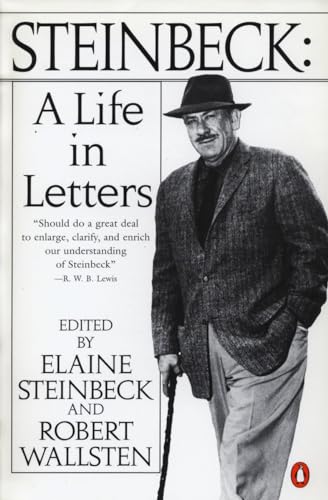
Review of: Steinbeck, A Life in Letters


Steinbeck: A Life in Letters: Steinbeck, John


edited by Elaine Steinbeck & Robert Wallsten

"In sixty years I've left a lot of tracks." This John Steinbeck
 said just six years before his death. His method of warming up
to write each day was letter writing and what a gift to the world!
This tome, and it is a tome, is 848 pages. It is a sampling of over
5.000 letters Steinbeck wrote during his life.
For me, it was better than an autobiography could have been because
it illustrated his relationships with the people in his life.
And I think it is more factual than a memoir could be,, because the
letters were written in Steinbeck's present time.
And I believe since letters are prima facie evidence,  no biographer
(without the use of them) could have captured the character of
John Steinbeck as a writer or as a man, better.
Elaine was Steinbeck's third and final wife. She was his companion
the longest-eighteen years. He said that he was happiest with her, so
she probably knew him best.
Robert Wallsten was a long time friend of both the Steinbecks.
The letters are John Steinbeck unplugged, unedited, being himself
on paper, writing about the writer he was becoming, became and his
thoughts on life, which are very much reflected in his 29 novels and
plays.
If you're a John Steinbeck enthusiast, as I am, you know he earned
both the Pulitzer and Nobel prizes for his writing. He was not only
one of our greatest American writers, he was internationally acclaimed
and never left our soil until after he was already famous.
I write this today before returning the book to the library. I plan to
own a copy when opportunity presents itself.
I highly recommend Steinbeck, a Life in Letters. It is not only a
valuable piece of treasured Americana, but a valuable piece of
world history.

raintreepoet, reporting

P.S. I am back! I have been re-writing a novel this summer; The Legend of Brady Madden.
by R.M. Knight. Look for it on ebook in the fall.

Friday, June 17, 2016

Review of: Burning Bright by John Steinbeck


Image result for free images of coverof Burning Bright by John Steinbeck

Burning Bright
 by John Steinbeck was written just before
East of Eden . He titled it: Burning Bright, A Play in Story Form
Burning Bright reminds me of a medieval morality play which 
weighs and measures what is important in the end, which is ultimately
love. 
Steinbeck divided BB into three acts- The Circus, The Farm and The 
Sea. There were only four characters- the husband, the father (sperm
donor) the mother and the friend. 
The friend he named Friend Ed (his dear friend Ed Rickets was killed
in a train accident a couple years prior) was the pivotal advisor who 
supports the mother, Mordeen and teaches the husband, Joe Saul how 
 to feel about their child, fathered by Victor because Joe was sterile.
When Joe Saul rejects Mordeen for her adultery to give him a child,
Friend Ed tells him: "It's so easy to give-only great men have the 
courage and the courtesy and, yes, the generosity to receive." 
This gem of wisdom turns the tide of Joe Saul's soul and he accepts
and embraces his wife and her gift to him his child.
Steinbeck dedicated Burning Bright to his new love, Elaine, who 
was bringing her ex-husband's child into his life. Did that
in part, help inspire this story?
Steinbeck's title is also significant in that he was about to write 
what he considered his most important book; East of Eden and he
was feeling at full "burning bright" power both personally and 
professionally. Note: Some of this insight was gleaned from the 
reading of Steinbeck, A Life in Letters.

Burning Bright was also produced as a play in New York.
Burning Bright is another short (93 pages) insightful Steinbeck
novel, which I enjoyed very much. It is available at local libraries.

raintreepoet, reporting.

Wednesday, June 15, 2016

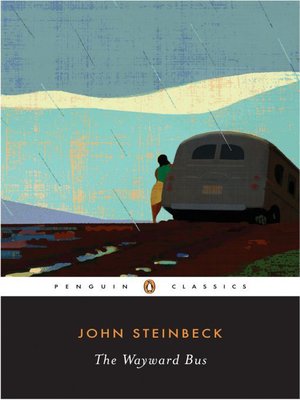
Review: The Wayward Bus


The Wayward Bus by John Steinbeck is a novel that
features Character Character Character more than Location
Location Location mainly because the primary location of
the action is a portable public conveyance-a bus.
Juan, the driver, delusioned by his religious symbol telling
him to flee his marriage agrees to the trip for all the wrong
reasons.
Alice, Juan's drunk wife, who runs the eatery attached to Juan's
garage and who harbors her own jealous fantasies regarding her
 coarsely handsome husband stays behind to get morbidly drunk.
Camille, a blonde beautiful traveler, who is a stripper pretending
to be a dental nurse because she is Everyman's fantasy and is strong
enough to simultaneously play them and resent them.
"Pimples," Juan's homely, bad skinned assistant who wants Camille, but
eventually tries to force himself on Norma ,Alice's runaway waitress,
who is headed to Los Angeles to find Clark Gable, her fantasy man
and/or a happier way of life, but Norma has acquired some sense of
self-esteem through the new mask Camille helped her apply, so she
fights him off.
Then there are the Pritchards, CEO, spoiled wife and angry college-
aged daughter Mildred, who are slumming on this bus on their way
to a Mexican vacation because the dad is curious about the common
people. Of course the Pritchards are entitled and quite put out by the
inconvenience of the bus getting stuck and his corporate wife loses
her cool and lets loose a revealing tirade that embarrasses Mildred
and forces her to take off on a walk. Steinbeck throws in a traveling
salesman/war vet to enrich the stew.
The Wayward Bus is all good fun on the shallowest level kind of like
the Jerry Springer Show, however, Steinbeck digs deeper into the characters
much like Chaucer did in "Canterbury Tales" and The Wayward Bus
ends up provocative/thought-provoking as Juan comes to and returns
to organize a digging out of the mud and righting the bus and continuing
on their journey.
There are so many more facets to John Steinbeck's work than I formerly
was aware of. I am really enjoying this reading adventure. The Wayward
Bus is riveting! I borrowed my copy from the local library.

Raintreepoet, reporting.

Sunday, June 12, 2016

To a God Unknown

Grief strikes sometimes deeper than tears.
Joseph Wayne comes to believe that a mighty oak tree on his land is inhabited
by the spirit of his father.
When he invites his brothers to settle near him he has no idea that one brother, a
religiously zealous Christian will decide that Joseph's "worship" of this tree
is a pagan sin.
Not only does he move his family away, when Joseph refuses to follow his more
traditional beliefs, but he plans the destruction of the tree, as well.

This rich allegorical story took five long years for Steinbeck to get it how he wanted
it. It was not one of his most popular novels, but I think it could take the prize for the
most philosophically deep. I enjoyed it tremendously as I think perhaps most English
majors would...perhaps religious studies majors, too.
 To a God Unknown has rich well crafted settings and intricate character portraiture,
Steinbeck's main strengths aside from dang good storytelling.

raintreepoet, reporting.